
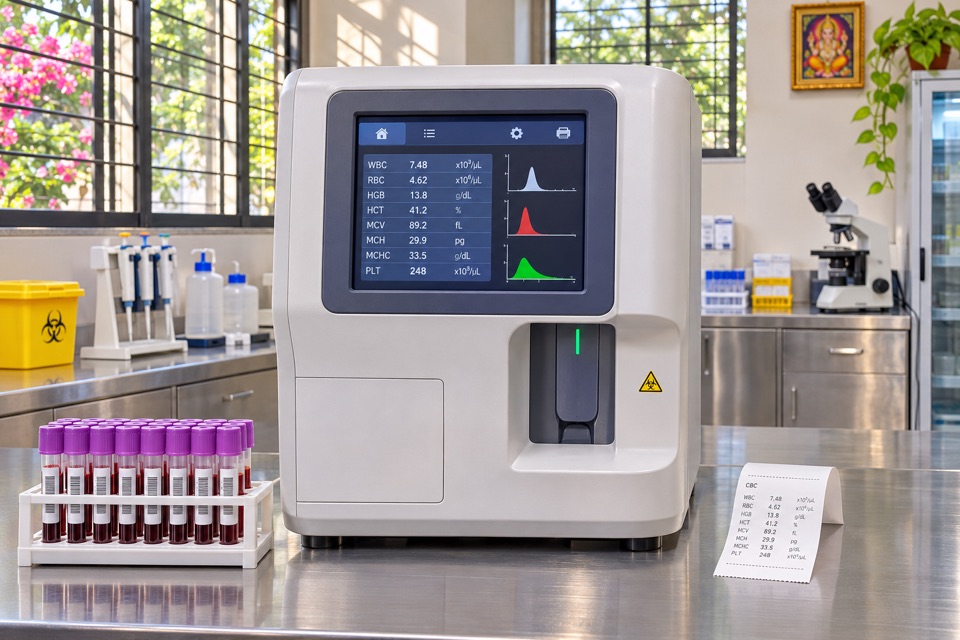
A lab result passes through several hands before it reaches the patient: the person placing the order, the technician entering values, the clinician reviewing them and the desk sending the report. A digital lab report needs to carry enough context to survive that journey. A neat PDF is only one part of the workflow.
For clinics and small hospitals choosing lab reporting software in India, the useful question is whether the same patient, test, result and report status stay connected from order entry through delivery. Here is what to look for.
What should a digital lab report contain?
Start with an unambiguous patient identifier, the issuing facility, an order or report number and the relevant dates. Patient names alone are a poor way to distinguish records. On a report that runs across several pages, repeat the patient identifier and order number so a loose page can be matched correctly.
Each result needs a clear test or parameter name, its value, its unit where applicable and the laboratory's applicable reference interval. Keep panel members together and preserve a consistent sequence. A report reader should not have to guess which heading a value belongs to.
Keep units and reference ranges attached to the result
A number copied without its unit or reference interval loses context. Software should preserve the interval used when the result was entered, rather than silently substituting a newly edited catalog range when an old report is opened. Where the laboratory configures age or sex-specific intervals, the applicable interval should be visible on the issued report.
High and low flags should remain understandable on a monochrome printout. Use letters or labels alongside colour. These flags support review; they do not establish a diagnosis or replace the laboratory's clinical processes. Qualitative results also need appropriate handling instead of being forced into a numeric field.
Make interim, final and verified mean different things
If one test is ready and another is pending, an interim report should clearly identify what is awaited. The arrival of the remaining values can make the report complete, but completeness and professional verification are separate events. Ask a software vendor how each is recorded and displayed.
Before adopting a workflow, walk through an amendment too: a value is corrected after a PDF has already been handed to the patient. The team needs to know which version was issued, who changed the result and how the corrected report reaches its recipient. A fresh PDF alone does not explain that history.
Plan patient delivery as part of the workflow
Printing, downloading and sending a report by SMS or WhatsApp are different handoffs. Confirm the intended recipient and destination before sending. A phone number recorded at registration may belong to an attendant or be shared by a family; it should not automatically settle who receives a report.
Ask whether a message sends an attachment or a link, whether links expire, and what the team can do after a wrong-number send. The message should accurately describe its contents and make an interim report recognisable. Staff also need a way to see delivery failures and offer a printed copy when digital delivery does not suit the patient.
How does LOINC fit into lab reporting?
LOINC identifies health observations and measurements. Using a standard test identifier helps systems describe which observation a result represents. The value, unit, reference interval and patient context still need to travel with it. For the broader picture, read our guide to LOINC, ICD-10 and SNOMED CT.
A useful demo follows one order all the way through
Try a multi-test order, enter only some results, preview an interim report, complete the rest, print a multi-page copy and practise a correction. Then check the patient's record and the delivery history. This reveals more about everyday usability than a gallery of report templates.
Lab reporting works best when it stays connected to the consultation and the patient record. Our overview of hospital management software in India explains how these workflows fit into the wider facility.